

Need to Know
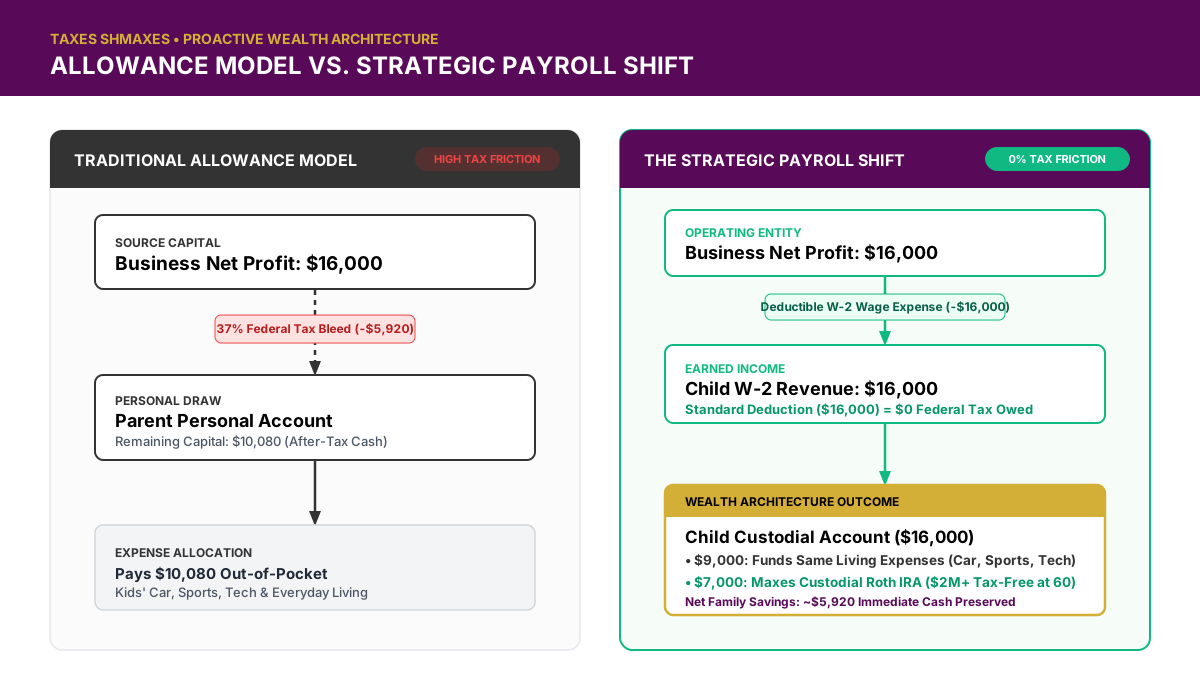
- The Core Strategy (Income Shifting): Business owners can hire their minor children to perform legitimate, age-appropriate work, shifting taxable business revenue from the parent’s highest federal bracket (up to 37%) into the child’s 0% federal tax bracket via the standard deduction (projected at $16,000 in 2026).
- Instant Tax Savings: Deducting up to $16,000 in wages per child generates roughly $5,000 to $5,920 in immediate federal income tax savings per child each year.
- The Payroll Tax Exemption: When children under age 18 are employed directly by a parent’s Sole Proprietorship, Single-Member LLC (disregarded entity), or a spousal partnership, their wages are completely exempt from FICA (15.3% Social Security and Medicare) and FUTA (Federal Unemployment) taxes.
- The S-Corporation Trap & Family Management Company Fix: S-Corporations do not qualify for the statutory FICA exemption when hiring an owner’s child. To solve this, business owners establish a separate Family Management Company (Sole Proprietorship / SMLLC) that provides administrative, marketing, or facility management services to the operating S-Corp and employs the children FICA-free.
- The “Allowance Swap” & Roth IRA Multiplier: Instead of paying for sports gear, cell phones, gas, and clothes with after-tax personal funds, kids pay for personal expenses with earned income. Crucially, earned income unlocks the ability to contribute up to $7,000 annually (in 2026) into a Custodial Roth IRA, compounding tax-free into millions of dollars by retirement age.
- IRS Compliance Standards: To survive IRS scrutiny, the compensation must be reasonable (market rate), the duties must be age-appropriate and documented with written job descriptions and timesheets, and wages must be processed formally with year-end W-2 filings.
If you are a successful, high-earning business owner, you are likely making one of the most expensive financial mistakes in modern parenting.
Every single month, you write checks for your children’s club sports, private school tuition, new smartphones, car insurance, summer camps, and college funds. But consider the hidden friction: where is that money coming from? You are paying for those lifestyle expenses out of your personal checking account using leftover, heavily taxed dollars.
If your business nets substantial profits, the IRS takes up to 37% in federal income taxes—plus state income taxes and payroll assessments—before you ever spend a single dollar on your own family. You are effectively earning $1.60 to $1.80 just to give your child $1.00 for soccer gear or gas.
The top 1% of business owners and forward-looking entrepreneurs do not fund their children’s lives this way. Instead of handing out arbitrary allowances from after-tax income, they hire their children directly inside their business.
In 2026, putting your kids on payroll remains the single most effective, 100% legal generational wealth hack codified into the Internal Revenue Code. It allows you to transform nondeductible personal family expenses into legitimate corporate write-offs, eliminate payroll taxes, and seed a multi-million-dollar tax-free retirement nest egg for your children before they even graduate high school.
Here is the blueprint for how to execute this strategy correctly, avoid costly IRS audit triggers, bypass the S-Corporation payroll trap, and build enduring family wealth.
1. The Mechanics of Bracket Shifting: Moving from 37% to 0%
At its foundational level, hiring your children is an exercise in tax bracket arbitrage (also known as income shifting).
When you generate $100,000 in net business income and draw it into your personal account to pay for family expenses, that money is taxed at your top marginal tax bracket. For driven entrepreneurs, that marginal federal bracket easily reaches 32%, 35%, or 37%.

When you hire your child as an employee to perform legitimate work for your business, their compensation becomes a 100% deductible business expense. This deduction reduces your business’s taxable ordinary income dollar-for-dollar.
The Standard Deduction Shield
Under federal tax law, every individual taxpayer is entitled to a standard deduction against their earned income. In 2026, the standard deduction for a single filer is approximately $16,000.
When your child earns up to the standard deduction threshold:
- The Business Deduction: Your company deducts the full $16,000, lowering your top-tier taxable income.
- Zero Federal Income Tax: Your child reports the $16,000 W-2 earnings on their tax return, applies the standard deduction against it, and pays $0 in federal income tax.
| Tax Scenario | Parent’s Top Bracket | Child’s Bracket | Immediate Federal Tax Saved |
|---|---|---|---|
| Traditional Allowance ($16,000) | 37% ($5,920 paid) | N/A | $0 |
| W-2 Child Payroll ($16,000) | 0% ($16,000 deducted) | 0% (Standard Deduction) | ~$5,000 to $5,920 in cash saved |
By shifting that $16,000 across the kitchen table from your 37% bracket into their 0% bracket, you keep roughly $5,000 to $6,000 in cold, hard cash inside your household. If you have two or three teenage children performing verifiable work in the business, those annual household tax savings multiply to $10,000–$18,000 every single year.
The State Tax Factor
On the federal level, this income is sheltered completely by the standard deduction. If your business operates in zero-income-tax states like Florida, Texas, Nevada, or Wyoming, your family enjoys a clean double win—zero federal tax and zero state tax.
If you reside in high-tax jurisdictions such as California, New York, or New Jersey, the child may owe a modest state income tax if the state standard deduction is lower than the federal threshold. However, because the child’s state tax bracket will be at the absolute lowest baseline (often 1% to 4%), the spread between the parent’s top marginal state rate (which can exceed 10% to 13%) and the child’s rate still yields substantial state-level net tax savings.
2. The Golden Rule: Legitimate Work and Age-Appropriate Roles
A major misconception propagated across social media is that you can simply put an infant on your company’s payroll as a “board member” and write off tens of thousands of dollars.
The IRS is not blind. Attempting to pay a three-year-old $15,000 to provide “strategic consulting” or “business management” is an immediate audit trigger that will result in disallowed deductions, back taxes, and severe penalties.
To be fully compliant under IRS scrutiny, the employment must satisfy two fundamental tests:
- The work performed must be real, necessary, and age-appropriate.
- The compensation must be reasonable based on prevailing market rates.
| AGES 7 TO 12 | AGES 13 TO 18 |
|---|---|
| – Janitorial & Shop Maintenance – Fleet Vehicle Washing & Detailing – Job-Site Cleanup & Debris Removal – Document Shredding & Mail Prep | – Social Media Content & Short Video – Basic Bookkeeping & Data Entry – Inventory Management & Shipping – Client Intake & Phone Reception |
Approved Roles by Age Tier
- Ages 7 to 12 (Operational & Maintenance Support): Children in this age range can handle physical, support-level tasks that you would otherwise hire an outside cleaner or junior assistant to perform. This includes cleaning the corporate office, washing and detailing commercial fleet vehicles, sweeping warehouses, shredding confidential files, and stuffing promotional mailers.
- Ages 13 to 18 (Digital, Administrative & Client Operations): Teenagers possess substantial technical aptitude. They can legitimately run your company’s social media channels (filming and editing TikToks, Instagram Reels, and YouTube Shorts), execute basic data entry, manage digital document organization, answer phone lines, assemble product sample kits, and manage physical inventory counts.
- Minors Under Age 7 (Commercial Modeling & Advertising): While toddlers cannot perform administrative labor, businesses that produce promotional brochures, billboards, print advertisements, or active website media can legitimately pay young children a standard commercial modeling fee for appearing in marketing campaigns. The compensation must strictly reflect what an independent modeling agency would charge for a child actor.
Establishing “Reasonable Compensation”
You must pay your child an hourly wage that is consistent with what you would pay an unrelated third party for identical services in your local market.
If the prevailing local wage for commercial office cleaning or job-site sweeping is $18 to $22 per hour, paying your 11-year-old child $20 per hour is fully defensible. Conversely, paying that same child $250 per hour to sweep the shop floor will be deemed unreasonable by an auditor, causing the excess deduction to be reclassified as a nondeductible gift.
3. The Compliance Blueprint: Bulletproofing Against Audits
Treating your child like a genuine employee on paper is non-negotiable. If an auditor examines your corporate tax return, they will look for the exact same administrative substantiation required for any W-2 hire.
To build an audit-proof foundation, complete the following formal protocol checklist:
| # | Compliance Requirement | Implementation Standard |
|---|---|---|
| #1 | Formal Job Description | Written summary of duties & roles |
| #2 | Employment Paperwork | Form W-4 and Form I-9 on file |
| #3 | Contemporaneous Timesheets | Weekly log of dates, hours & tasks |
| #4 | Segregated Bank Account | Child’s own custodial checking/saving |
| #5 | Formal Payroll Processing | Electronic direct deposit or check |
| #6 | Year-End Form W-2 | Timely SSA/IRS filing by January 31 |
Draft a Formal Job Description: Create a written document outlining the child’s job title, core responsibilities, direct supervisor, and hourly pay rate.
Execute Onboarding Paperwork: Have the child complete IRS Form W-4 (Employee’s Withholding Certificate) and USCIS Form I-9 (Employment Eligibility Verification). Keep these in your corporate records.
Maintain Contemporaneous Timesheets: The child must log their hours as they work. Use digital time-tracking applications or physical timesheets detailing the date, start time, end time, total hours worked, and specific tasks completed.
Open a Dedicated Child Bank Account: Wages cannot be transferred into a parent’s personal checking account. Open a custodial checking or savings account (UTMA/UGMA or joint youth account) exclusively in the child’s name and Social Security number.
Run Formal Payroll: Pay wages on a regular, structured payroll schedule (bi-weekly or monthly) via direct deposit or formal corporate checks made out directly to the child’s account.
File Form W-2: At the end of the calendar year, issue a formal Form W-2 reporting total wages paid and submit the corresponding copies to the Social Security Administration and IRS by January 31.
4. The “Allowance Swap”: Repurposing Everyday Expenses
Once your child’s paycheck hits their custodial account, the dynamic shifts from tax savings to cash flow optimization. This is the Allowance Swap.
When your teenager asks for money to buy video games, brand-name clothes, sporting equipment, concert tickets, gas for their car, or auto insurance, you no longer pay for these items out of your own wallet.
You instruct your child to utilize the earned income in their dedicated account to cover their personal lifestyle costs. Because those funds were paid out by your business tax-free, everything your child purchases is effectively acquired at a 30% to 40% discount compared to buying them with your post-tax dollars.
You eliminate out-of-pocket allowance drains while simultaneously instilling financial literacy, budgeting discipline, and a strong work ethic in your children at an early age.
5. The Multiplier Effect: Funding a Tax-Free Custodial Roth IRA
While saving $5,000 to $6,000 per year on your income tax return is an immediate win, the true power of hiring your kids lies in generating earned income.
To legally contribute to a Roth IRA, the IRS requires the account holder to have taxable compensation (earned W-2 or self-employment income). Minors who receive an allowance or investment dividends cannot fund an IRA. But a child on your payroll now has verifiable earned income.
In 2026, an individual can contribute up to $7,000 per year (or 100% of earned income, whichever is less) into a Roth IRA.
The Compounding Math: Building a Tax-Free Dynasty
Consider what happens when a parent employs their 10-year-old child and helps them contribute the maximum $7,000 annual contribution into a Custodial Roth IRA for just 8 consecutive years (ages 10 through 17):
- Annual Contribution: $7,000 per year
- Funding Duration: 8 years (Total principal invested: $56,000)
- Assumed Market Growth Rate: 9% annualized return (S&P 500 historical average)
- Additional Contributions After Age 18: $0 (No further funds added)
By leveraging income shifting and compound interest, you have not merely lowered your tax liability today; you have effectively purchased your child’s retirement outright.
When your child accesses this capital in retirement, every single dollar of that multi-million-dollar balance is 100% exempt from federal and state income taxes.
The Liquidity Advantage: Penalty-Free Basis Withdrawals
A Roth IRA is not an illiquid lockbox. Under IRS ordering rules, direct contributions (basis) made to a Roth IRA can be withdrawn at any time, for any reason, completely penalty-free and tax-free.
If your child reaches age 25 and needs capital for a down payment on their first home, emergency reserves, or funding a new business venture, they can pull out their original $56,000 principal contribution without triggering early withdrawal penalties or taxes, leaving the accumulated growth to continue compounding untouched.
6. The FICA Exemption & The S-Corporation Workaround
Executing this strategy seamlessly requires understanding the underlying entity structure of your business.
Under Section 3121(b)(3)(A) of the Internal Revenue Code, wages paid to a child under the age of 18 are completely exempt from FICA taxes (Social Security and Medicare, totaling 15.3%) if the child is employed by:
- A Sole Proprietorship owned by their parent
- A Single-Member LLC owned directly by a parent (disregarded entity)
- A General Partnership or multi-member LLC where the only partners are the child’s parents (husband and wife)
Under these qualifying entities, wages are also exempt from Federal Unemployment Tax (FUTA) until the child turns 21. The money moves out of your business and into the child’s hands completely untouched by payroll taxes.
The S-Corporation Trap
Most scaling entrepreneurs do not operate as sole proprietorships; they elect to be taxed as S-Corporations to reduce self-employment taxes on their own business distributions.
Here is the structural trap: An S-Corporation is a distinct legal entity (a corporation), not a parent.
If an S-Corporation hires a child under 18 directly, the IRS does not recognize the family relationship exemption. The S-Corporation must withhold 7.65% from the child’s wages and pay an employer matching 7.65%, instantly surrendering 15.3% of the wages to payroll taxes (plus state unemployment and disability assessments).
The Strategist Fix: The Family Management Company (FMC)
To retain your S-Corporation status while capturing the full 15.3% FICA exemption, wealth strategists implement a Family Management Company structure:
- Form a Separate Sole Proprietorship or Single-Member LLC: The parent establishes a separate entity (a Single-Member LLC or DBA) designated as a Family Management Company (FMC).
- Execute an Inter-Company Services Agreement: The FMC enters into a formal business contract with your main operating S-Corporation to provide administrative support, social media marketing, IT maintenance, and janitorial management services.
- Bill Management Fees: The S-Corporation pays a market-rate management fee (e.g., $16,000 per working child) to the Family Management Company, creating a 100% deductible business expense inside the S-Corp.
- Hire the Children Through the FMC: The Family Management Company (as a sole proprietorship / disregarded SMLLC) hires your minor children to perform those contracted services.
- Capture the Full Tax Exemption: Because the children are employed by a parent-owned sole proprietorship, their wages are 100% exempt from FICA and FUTA taxes. The revenue flowing into the FMC is offset dollar-for-dollar by child payroll deductions, leaving zero net taxable profit inside the management company.
This multi-entity architecture allows your operating company to take a full corporate deduction while preserving complete payroll tax immunity for your kids.
Stop Preparing. Start Strategizing.
A traditional “historian” tax preparer will look at your minor children as nothing more than a static $2,000 Child Tax Credit on your personal return, often telling you that setting up payroll for your kids is “too much paperwork” because they do not want to manage the compliance filings.
A forward-thinking tax strategist looks at your children as the foundation for multi-generational wealth.
By implementing an audit-proof payroll system, utilizing the standard deduction, executing the Family Management Company workaround, and funding a Custodial Roth IRA, you can transform mandatory family living costs into an engine for permanent, tax-free generational wealth.
Do not leave thousands of dollars on the table by paying for your children’s lives with heavily taxed personal funds. If you are ready to upgrade your financial team and build an audit-proof blueprint for 2026, book a strategy consultation to evaluate your business structure and start architecting your family’s financial future. Book a free discovery call today → https://www.nisanovtax.com/book-a-discovery-call
*Disclaimer: This material is for informational and educational purposes only. The content provides general information regarding the subject matter covered and does not constitute legal, tax, or other financial advice related to individual situations. The tax code is highly complex, and because each individual’s legal, tax, and financial situation is different, specific advice should be uniquely tailored to your circumstances. For this reason, you should independently consult with your own attorney, accountant, tax preparer, or advisor regarding your specific situation before making any financial decisions.